
The Technology Behind the Names: How We’re Bringing Local War Memorials to Life
In a recent survey, 73% of respondents said they believe the stories behind the names on local war memorials are getting lost, and only 27% were confident they could name even one person commemorated on their local memorial. We wanted to change that and bring people the stories behind the names on their local WW1 memorials.
At scale, this is no small feat. What we know about any one soldier is scattered across dozens of record sets, both military and civilian. But with Findmypast’s records and newspaper archive, some carefully applied AI, and a brilliant group of engineers and data scientists, we’ve begun a multi-year project to do exactly that. Here’s how it works.
Step 1. Finding the soldiers
One of the things that has never been done before at this scale is reliably link everything we know about a soldier.
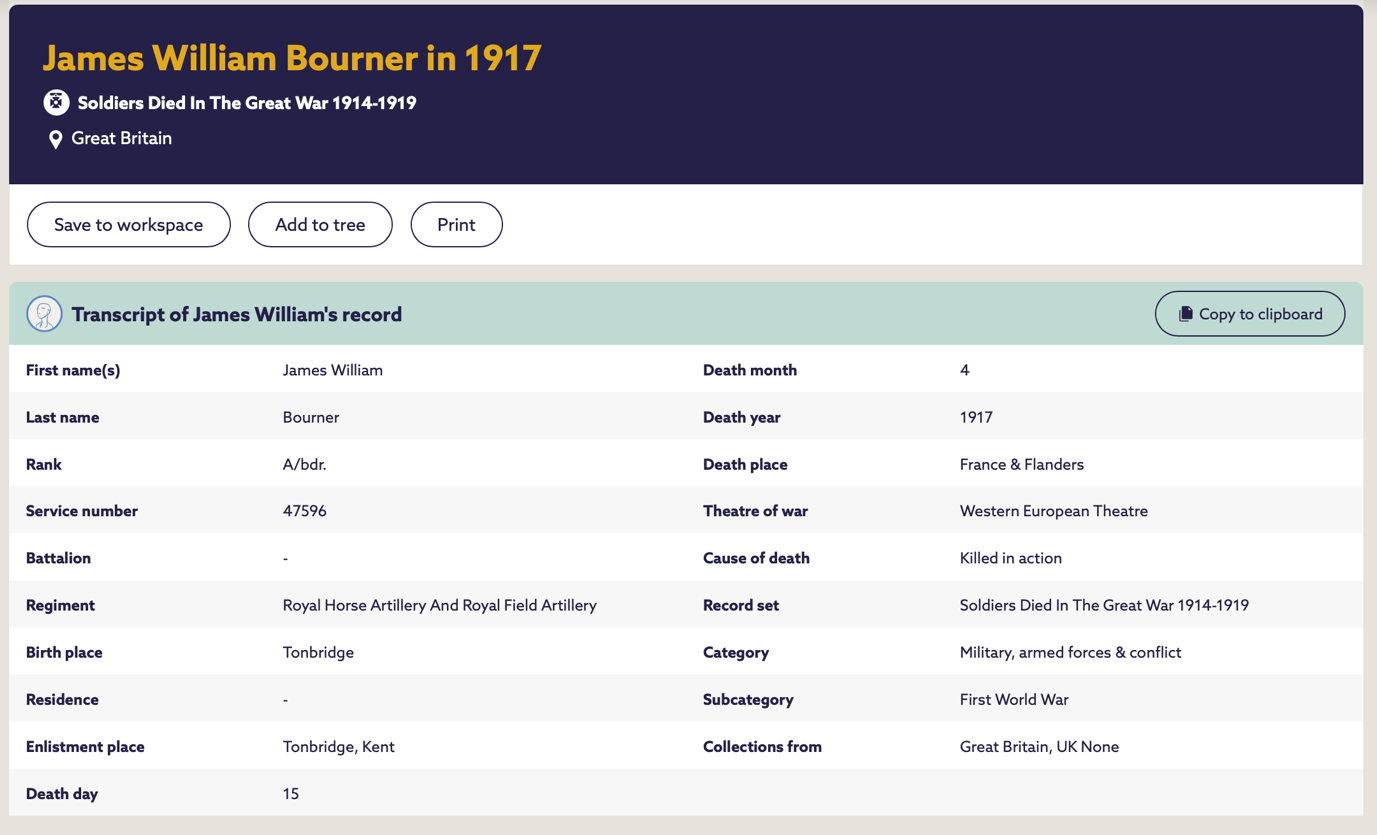
Russell Hunter (Engineer Mavericks team) started with two key record sets, both available on Findmypast: Soldiers Who Died in the Great War, and the Commonwealth War Graves Commission transcripts. By linking the two by name and service number we could establish the basic facts for each fallen soldier: place and date of birth, regiment, and place and date of death. From there it was a relatively short hop to medal index cards and surviving service records, giving us a clear picture of each man’s service during the war.
Step 2. Finding their civilian lives
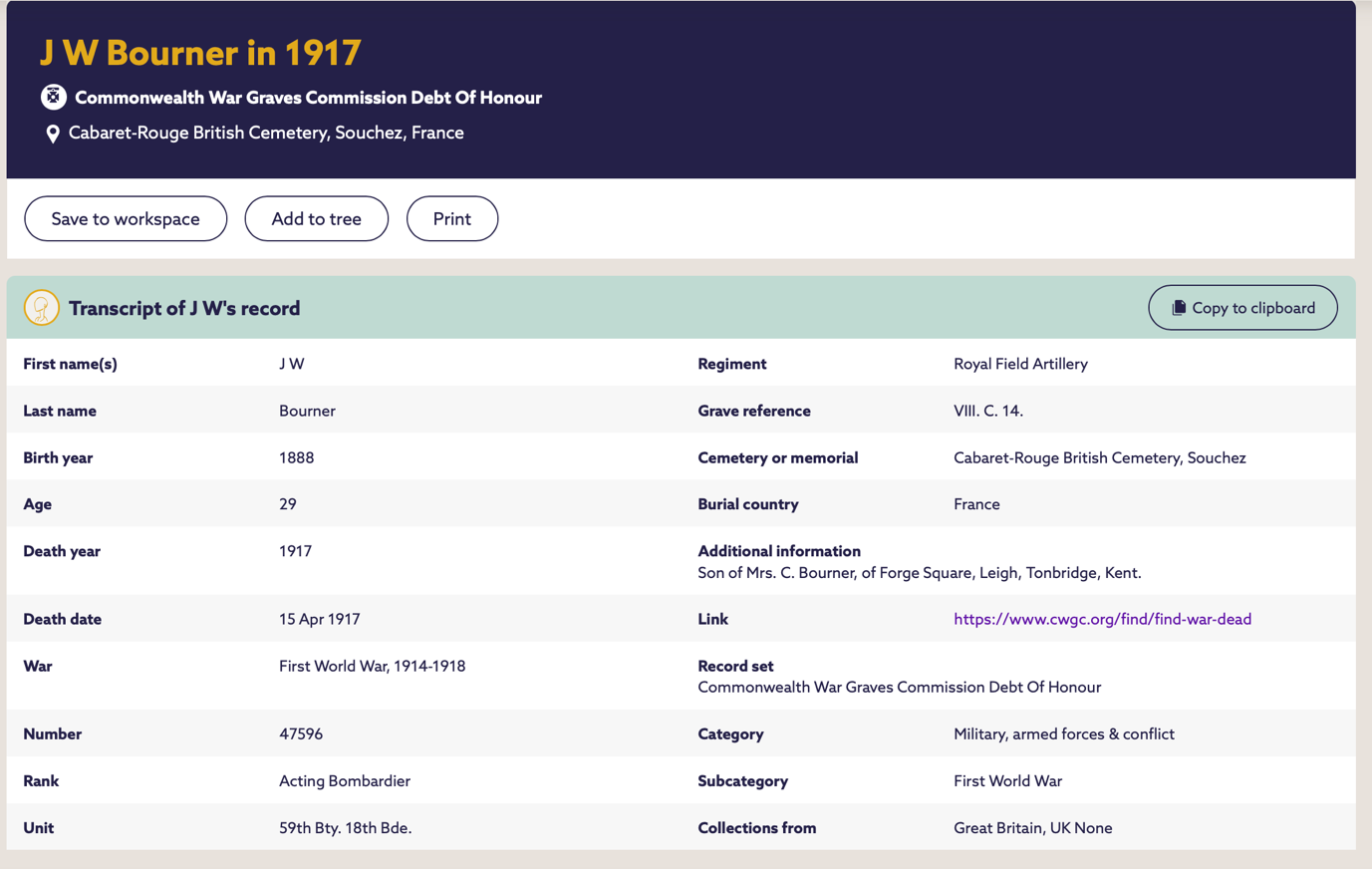
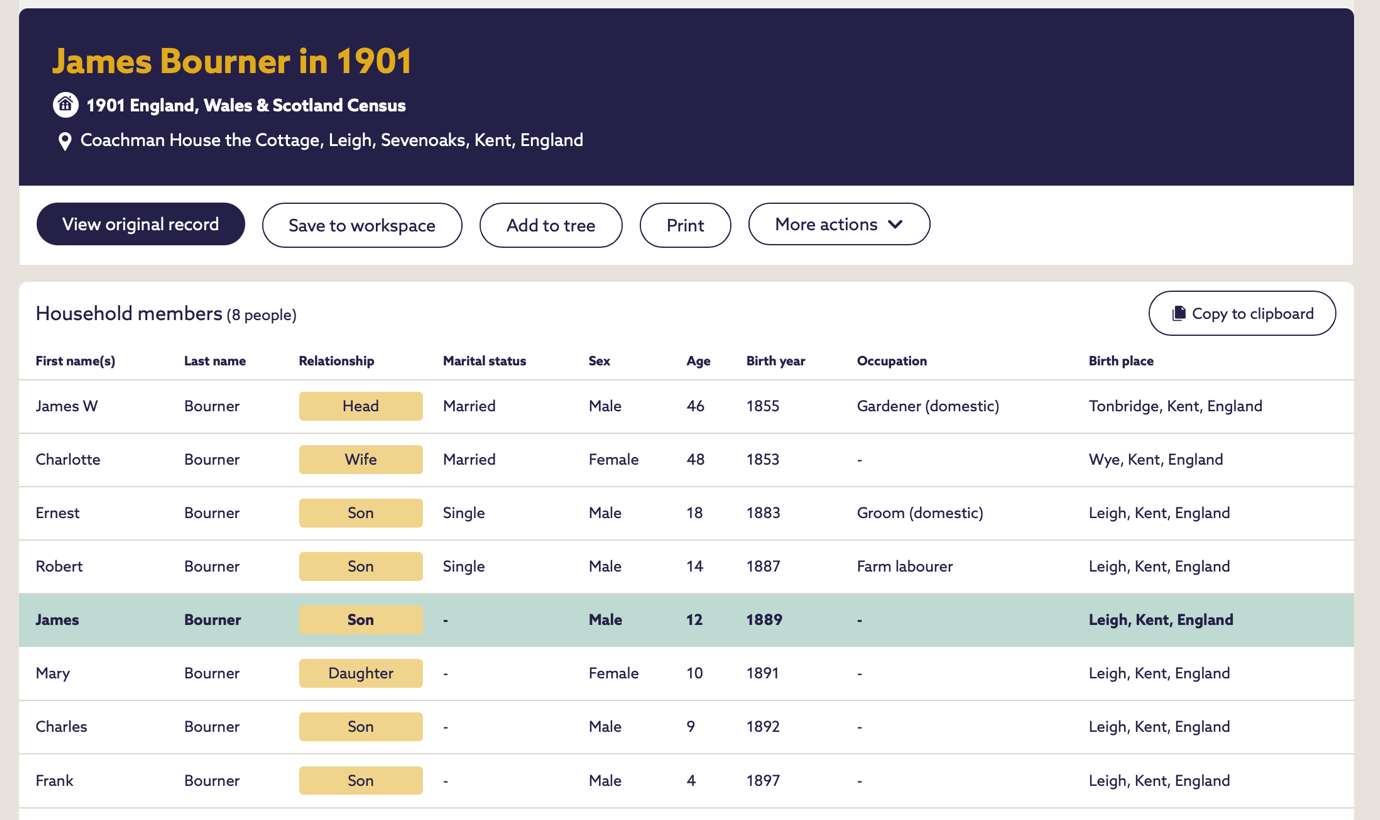
When it comes to finding out more about their civilian lives, we really wanted to create links from the military records to the 1891/1901/1911 census records. Birth date and place help to make these links, but the most valuable clue came from the CWGC family notes, which for many soldiers record the names and address of parents or a spouse. A search for James Bourner, born 1888, might return dozens of matches. A search for James Bourner, son of Mrs C Bourner, of Forge Square Leigh is going to narrow that down hugely.
Once we were able to make those matches, we could bring everything we knew about a man together into a single ‘soldier collation’.
Step 3. Building a connected graph
Behind the scenes, this project runs on a new approach to how we store people. Traditionally, genealogy is search-driven: every time you look for someone, the system searches, gathers candidate records and reassembles the picture from scratch. Instead, here we are building a persistent graph of people and relationships. Each real person exists only once, as a single node, and every record we match to them (census, birth, marriage and death registrations, military records, newspapers) enriches that node rather than creating another copy. This means we can resolve a person once, store them, and keep adding to what we know.
This matters because some of the most interesting questions in history are about connections. Once people are nodes and relationships are links, we can ask things that are extremely hard to answer with search alone: who served in the same battalion, who worked for the same employer, who lived on the same street in 1911, and how two men on the same memorial are connected. More on that later…
It is also important to mention, although intuitively we all know, historical data is messy. So from a technical perspective we also use embeddings (numerical representations of meaning) to compare things that don’t match letter for letter. Places are clustered across spelling variations and boundary changes. Jobs like “coal miner”, “hewer” and “collier” are recognised as related. Employers and institutions are grouped so shared workplaces surface, and name variants and aliases are handled more intelligently during matching. The result is a graph focuses on meaning, not just exact matches.
Step 4. Adding newspaper content
With a clear picture of each soldier, we could search our newspaper archive for him. Findlay Webb (Engineer Memento Team) led this work and found on average 3 articles for each man. For each man, an AI agent writes searches from what his records tell us: his name, regiment, service number, hometown, and family. Every article that comes back is then assessed on its own and checked against those records, so a namesake from the wrong town or with the wrong regiment is rejected.
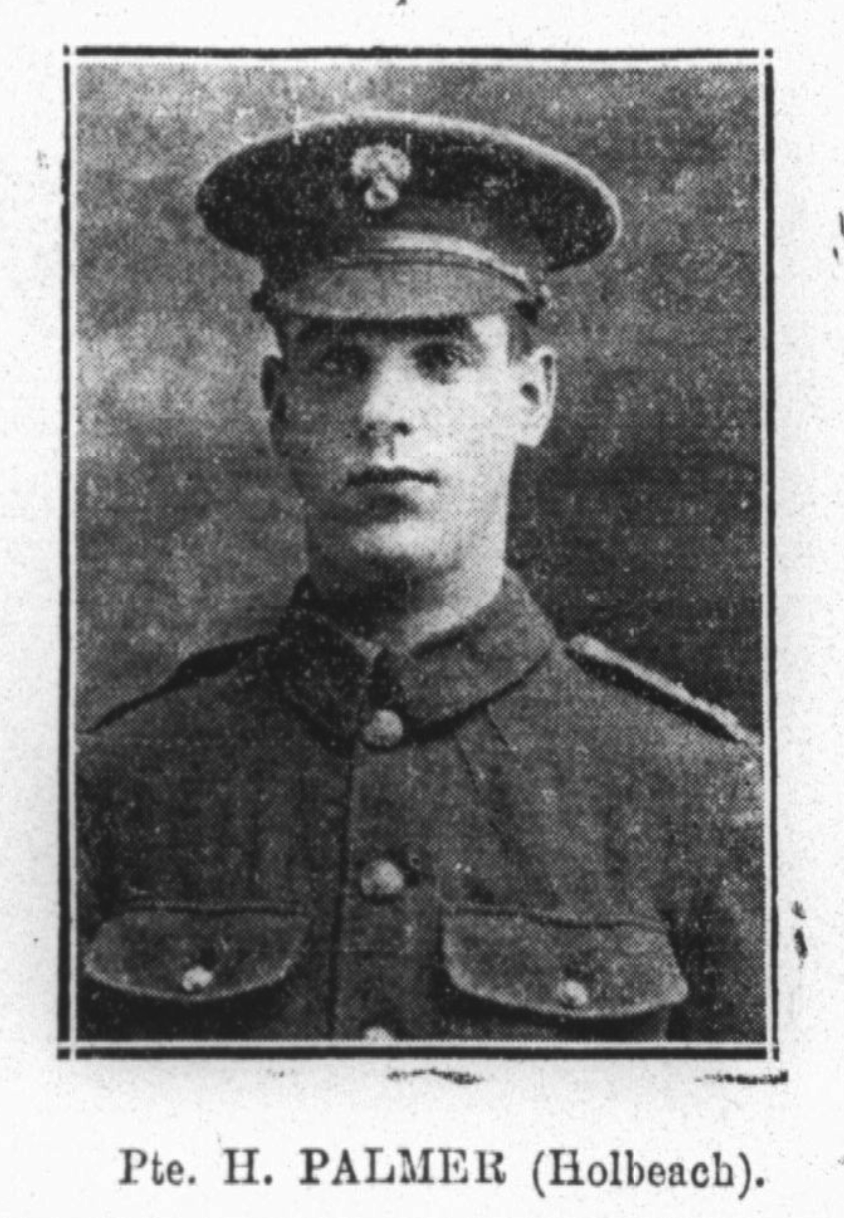
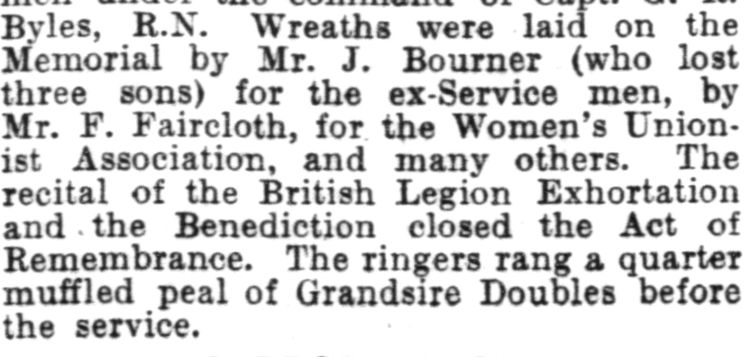
For Private Herbert Palmer of the Grenadier Guards, killed in July 1917, we found the notice of his death naming his parents in Fishpond Lane, Holbeach. We also found his portrait in the paper, an obituary noting he was buried on his 23rd birthday, and from before the war, a Sunday school prize list and a story where he was best man at his sister’s wedding.
Step 5. Attaching soldiers to memorials
Next came the hardest part: working out which memorials each soldier is remembered on.
Between 1919 and the mid-1920s, thousands of memorials were built across the UK. There was no central organisation, but rather local war memorial committees were established to raise funds, chose appropriate sites, commission designs and, crucially for us, draw up the lists of names, usually submitted by relatives and friends. You can see some of these submission records for the Bermondsey war memorial in our collection. Unfortunately for our project, many committees worked informally and their paperwork wasn’t kept.
So we went back to our newspaper archive to help solve this problem. Local papers often printed the names, sometimes as draft lists for checking that no man had been forgotten. These lists are gold dust: they frequently include full names, service numbers, addresses and regiments that the memorials themselves leave out.
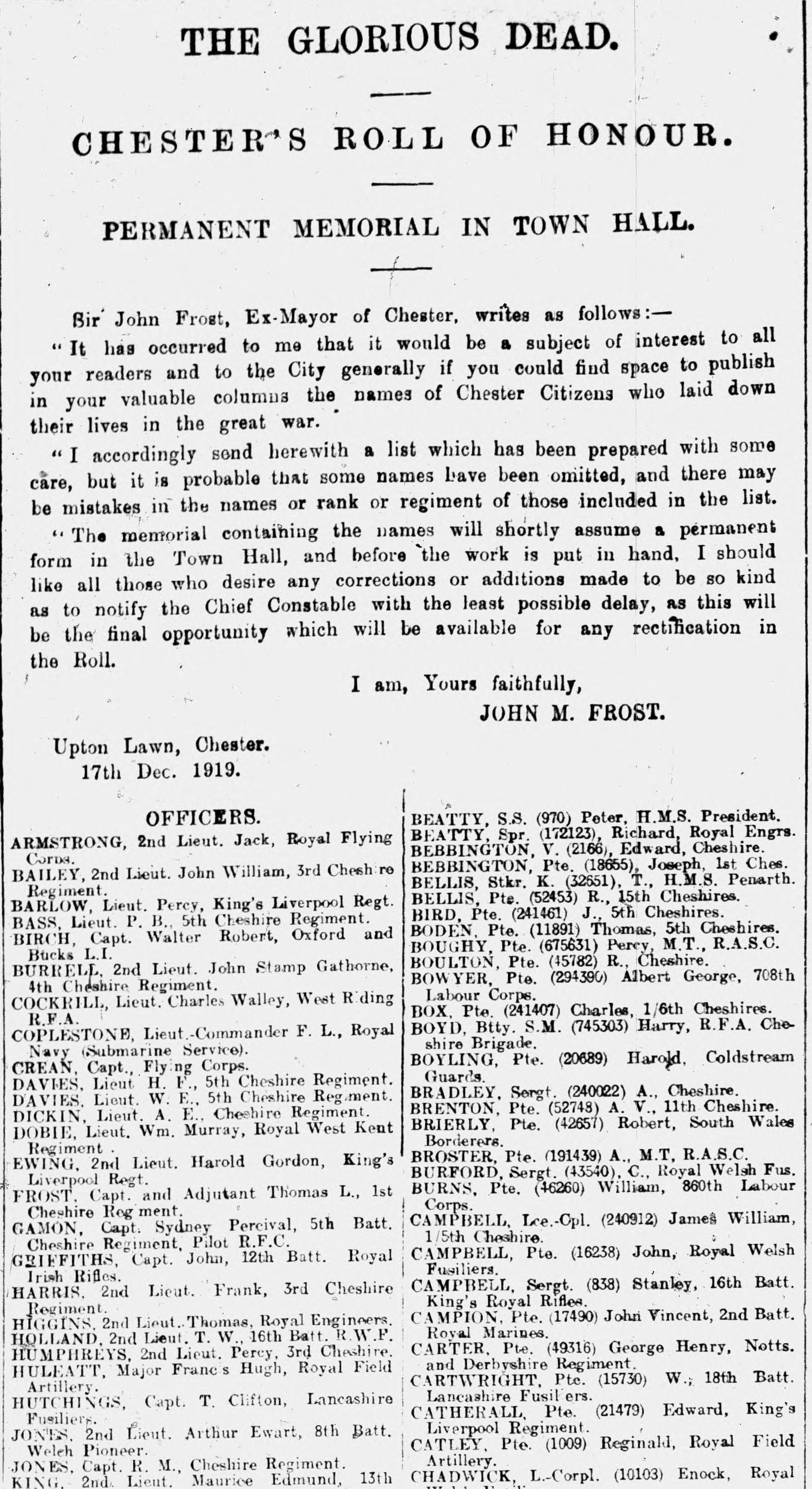
Unfortunately finding them at scale isn’t easy. Findlay started with a simple plan: search broadly, then have AI check each result. The real obstacle turned out to be wording. Committees up and down the country described their lists in many different ways, so the search had to learn their language. Each list we found taught us new phrases to search for (in Scotland, for example, relatives were asked to “intimate” names to the committee). We swept the whole archive from 1914 to 1935, county by county, and an AI model read and sorted every article that came back, hundreds of thousands in all. The machine-read text of old newspapers is often poor, and that matters most for the names themselves. So for each list we cut the article out of the original page scan and had an AI model read the names straight from the image.
One surprise was how rare draft lists were. Published rolls of honour outnumber them about twelve to one and supply most of the names. In all, the lists came from about 31,000 newspaper articles.
Using these lists alongside a soldier’s birthplace, his census addresses and his next of kin’s location in 1921, David Lack (Data Scientist) built a prioritisation system to identify the most likely memorials for each man. For unusual names this is relatively straightforward but for common names it’s much harder. Because no single source of truth exists, we can’t claim 100% accuracy, but we present the best-supported match using the same reasoning a genealogist would apply.
Step 6. Telling the stories of soldiers and communities
Still with me? Wonderful! Thank you for reading this far.
We now have a soldier collation for each man containing everything we know, with every fact tied to a source record. The final step was turning that into stories that anyone, especially people unfamiliar with our record sets, could read and understand.
Eduardo (Engineer, Product Experience) developed the prompts that turn each soldier’s profile into a narrative, following his life from birth through childhood, early work, marriage and family, to his military service and death. Because these are real people and important stories, accuracy came before everything else. The model is given only the facts in the soldier’s profile and is instructed not to add anything that isn’t supported by a record: no invented feelings, no imagined scenes, no assumed details. Where the evidence is uncertain, the narrative says so. We tested the output against a set of soldiers whose lives had been researched by hand, refining the prompts until the stories were both readable and faithful to the records. The aim isn’t to embellish these lives; it’s to make the records speak clearly.
But individual stories were only part of it. The men on a memorial knew one another: they were brothers, cousins, schoolmates, workmates and comrades. Harlei (Engineer Arborists Team) took all the soldiers connected to a single memorial and used an LLM, together with the relationships in our graph, to find the threads between them. Who was related? Who worked at the same mill or colliery? Who enlisted together or served in the same battalion?
Where do we go from here?
So where have we got to? Over 9,000 memorials and 300,000 men’s stories, built on a connected graph of records and newspaper articles. We believe it’s the first of its kind. The logic mirrors how a genealogist or local historian would piece together a single life, but AI has allowed us to do that research at a scale that would otherwise be impossible.
There are still thousands of names to investigate, and the team is constantly experimenting with new ways to reach them, so that no name is left behind.
We hope you will enjoy reading about the men remembered on your local war memorial, and that knowing the details of their lives in your towns and villages makes this Remembrance Day more personal and more poignant. If you enjoyed this work, drop me a line at sadair@findmypast.com and I’ll share your feedback with the technical team behind it.